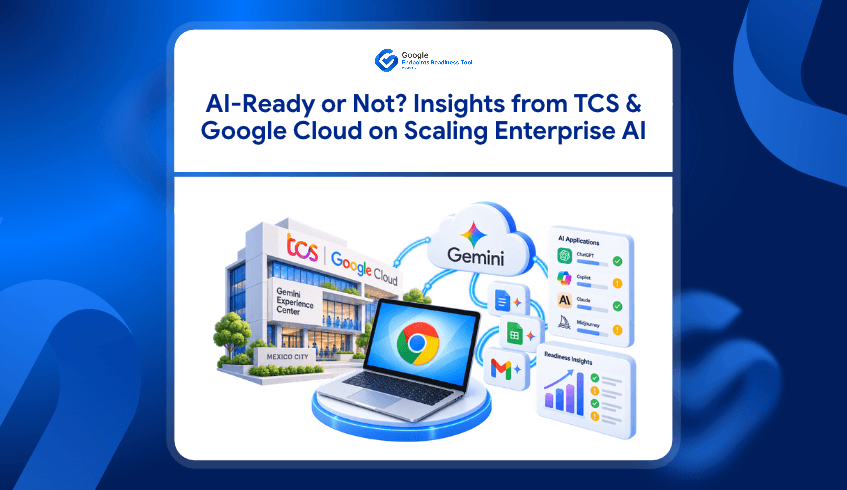
TCS and Google Cloud Show Why Enterprise AI Needs Readiness
Enterprise AI is moving beyond experimentation and into structured business adoption.
TCS and Google Cloud's Gemini Experience Center in Mexico City became TCS' ninth Gemini Experience Center worldwide and second in Latin America. The center is designed to help organizations accelerate enterprise AI adoption, develop AI-driven solutions, and move from experimentation toward implementation.
That shift matters for IT teams. As AI becomes part of daily work, organizations need to understand which AI applications are already installed across their environment. AI strategy should not begin only with the target platform. It should also begin with visibility into the AI applications already present on organizational devices.
That is where Chrome Readiness Assessment helps through AI Application Insights.
Enterprise AI Is Becoming a Planning Priority
The early phase of enterprise AI was often driven by experimentation. Teams tested generative AI tools for writing, research, analysis, development, customer support, and process improvement.
Now, AI adoption is becoming more structured. The Mexico City Gemini Experience Center highlights this shift by focusing on enterprise AI use cases, industry-specific solutions, and practical implementation across sectors such as financial services, retail, manufacturing, healthcare, life sciences, and energy.
For IT teams, this creates a new readiness question. It is not only about whether the organization wants to adopt Gemini Enterprise. It is also about understanding which AI applications are already installed before a larger strategy is rolled out.
AI Adoption Can Happen Before the Strategy
Enterprise technology strategies are usually planned centrally. Employee technology usage is not always.
An employee may install an AI application and use it for daily work before that tool becomes part of the official roadmap. A team may adopt an AI assistant for research, documentation, customer tasks, or workflow support. Over time, these individual decisions can create a wider footprint of installed AI applications across the organization.
That does not mean every existing AI application is a problem. But it does mean installed AI applications should be visible before decisions are made about Gemini adoption, governance, or standardization.
Without that visibility, IT teams may not know which AI applications are installed, and which ones already have a suitable Gemini alternative.
AI Visibility Creates a Better Starting Point
A basic software inventory can show what applications exist. AI readiness needs more specific context, within a defined scope.
AI Application Insights in CRA focuses on AI applications installed on organizational devices. It does not track browser-based AI tools, extensions, or cloud platforms accessed through the browser, so the scope is downloaded applications rather than every way an employee might touch AI during the workday.
For each installed AI application, CRA identifies whether a suitable Gemini alternative exists, and points to the specific capability that fits, such as Gemini Chat for a general-purpose assistant, Gemini Workspace AI for productivity workflows inside Docs, Sheets, and Gmail, or Gemini Advanced for more complex reasoning tasks.
This gives IT teams a clearer starting point before making broader AI adoption decisions. Instead of treating every AI tool an employee might use as an unknown, teams can see which installed applications already have a mapped Gemini alternative and prioritize further review from there.
Readiness Should Come Before Large-Scale Deployment
The TCS and Google Cloud announcement highlights the growing focus on helping organizations operationalize AI. But successful AI adoption depends on more than access to the technology.
Organizations also need to understand the installed applications already present in that environment.
If employees have already installed multiple AI applications, those applications become part of the readiness conversation. Some may already have a clear Gemini alternative, some may need further review, and others may already align with the organization's direction.
Without visibility into what's installed, these differences are difficult to identify. With visibility, IT teams can prioritize what needs attention instead of evaluating every application equally.
That is the role of readiness assessment: providing evidence about installed applications that helps decision-makers understand the current state before defining the next one.
From AI Adoption to AI Readiness
The launch of another Gemini-focused enterprise initiative is a reminder that AI adoption is becoming an organizational planning issue.
As enterprises move from AI experimentation toward broader deployment, understanding which AI applications are already installed becomes increasingly important.
Chrome Readiness Assessment helps address that starting point through AI Application Insights. By identifying AI applications installed across organizational devices and showing which Gemini capability, such as Gemini Chat, Gemini Workspace AI, or Gemini Advanced, may serve as a suitable alternative for each one, CRA helps IT teams establish a clearer baseline for Gemini adoption and broader modernization planning.
For organizations also preparing for ChromeOS migration, AI readiness can be considered as part of the initial assessment rather than addressed later. CRA also looks at AI visibility from the browser side in Why Legacy DLP Tools Are Blind to Browser-Based AI Workflows
FAQ
What did TCS and Google Cloud announce? They announced a new Gemini Experience Center in Mexico City on August 11, 2026, designed to help organizations accelerate AI adoption and develop AI-driven solutions.
Why does enterprise AI adoption create a readiness challenge? Organizations need to know which AI applications are already installed across their environment, not just which platforms they plan to adopt.
What is AI Application Insights in CRA? It identifies AI applications installed on organizational devices and shows which Gemini capability, such as Gemini Chat, Gemini Workspace AI, or Gemini Advanced, may be a suitable alternative for each one.
Does AI Application Insights track browser-based AI tools? No. It focuses on AI applications installed on organizational devices, not AI tools or extensions accessed through the browser.
Does AI readiness mean existing AI applications must be replaced? No. Readiness visibility helps teams see which installed applications have a Gemini alternative and prioritize applications for review based on that evidence.