FOX Sports: From AI Experiments to Enterprise AI Operations
When FOX Sports prepared for the expanded FIFA World Cup, the challenge was not simply broadcasting more matches.
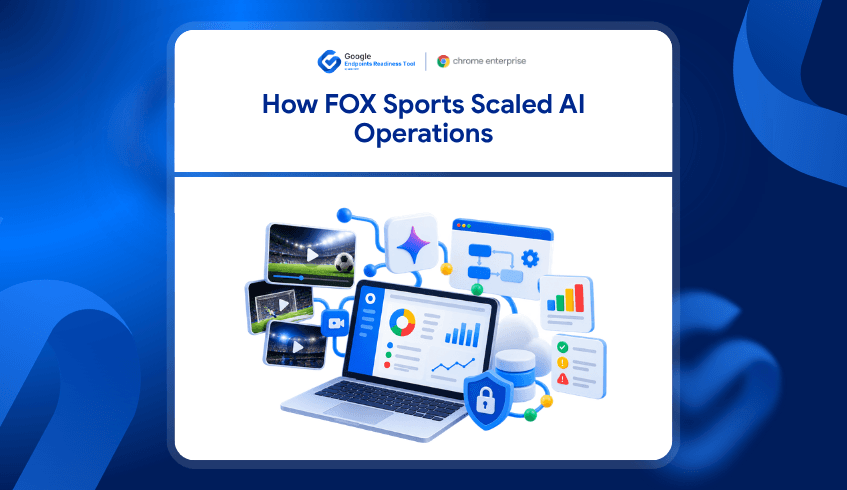
The tournament included 48 teams, 104 matches, 16 host cities, and generated more than 11,500 hours of recordings, 23,000 files, and 85,000 subclips. Production teams needed to find specific moments, interviews, and highlights within seconds while delivering content to audiences across multiple platforms in near real time. To support that scale, FOX Sports embedded AI deeply into its production operations, using Gemini-powered search, automated tagging, intelligent content discovery, and agentic workflows that helped teams locate and use content faster than ever before.
The technology challenge was not simply deploying AI. It was making AI useful across a large, distributed workforce.
As FOX Sports explained, the goal was to help more than 1,200 team members quickly find the information they needed while maintaining the reliability expected from one of the world's largest sporting events. Their approach demonstrates something many organizations are now discovering: successful AI adoption requires more than access to powerful models. It requires visibility, governance, and a clear understanding of where AI can create value.
Before organizations deploy Gemini, AI agents, or enterprise automation initiatives, they first need to understand how AI is already being used and which workflows are ready for deeper automation.
The Real Challenge Is Not Deploying AI
Most organizations already have AI inside their environment. Employees use browser-based AI assistants. Teams experiment with AI productivity tools. Developers install AI coding assistants. Departments adopt workflow automation platforms. Business users increasingly rely on AI features embedded inside applications they use every day.
The challenge is that many organizations cannot see the complete picture. AI adoption often happens faster than governance.
Different teams introduce different tools. Some applications are approved. Others are not. Some employees interact directly with AI platforms, while others use AI through existing productivity tools without realizing it. Before organizations can build enterprise-scale AI experiences like those seen at FOX Sports, they need visibility into what is already happening across their environment.
Understanding AI Usage Before Scaling AI Adoption
The FOX Sports deployment succeeded because the organization understood how AI would support real business workflows.
The objective was not AI for the sake of AI. The objective was helping teams discover content faster, automate repetitive tasks, and support production decisions in real time. AI became valuable because it was connected to meaningful work.
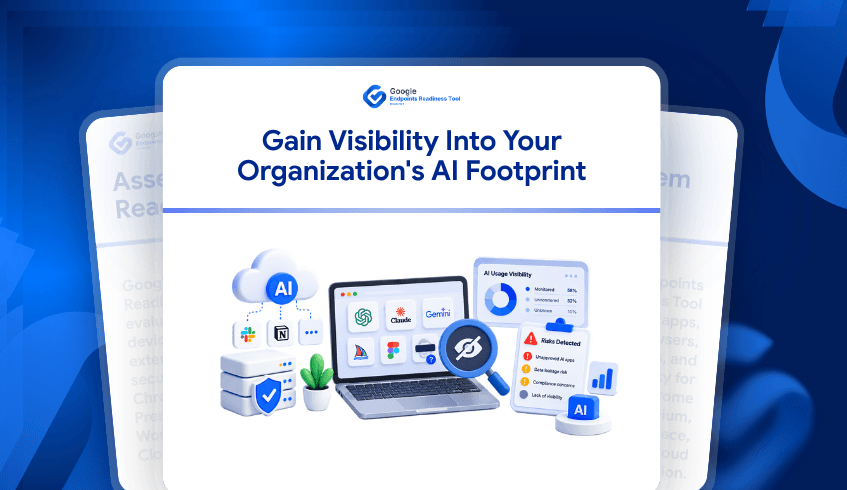
Organizations pursuing similar outcomes need the same level of understanding. The AI Insights capability within the Google Endpoints Readiness Tool helps organizations gain visibility into AI activity across their environment. It provides insight into installed AI applications, browser-accessed AI tools, local LLMs, workflow automation platforms and browser-integrated AI experiences.
This creates a more complete picture of AI adoption across the enterprise. Instead of relying on assumptions, IT teams can understand which AI technologies are being used, where they are being used and whether they align with organizational policies.
Visibility Is the First Step Toward AI Governance
As AI adoption grows, governance becomes increasingly important. Organizations need to understand not only which AI tools exist within the environment but also whether those tools should be approved for business use.
This challenge becomes more significant as employees adopt AI-powered applications independently. Browser extensions, local AI models, AI workflow platforms, and embedded assistants can all introduce governance and security considerations if they operate outside organizational oversight.
AI Insights helps organizations move beyond simple discovery. By identifying sanctioned and unsanctioned AI technologies across devices and browsers, organizations gain a clearer understanding of where governance policies may need to be strengthened. This allows teams to build AI strategies based on visibility rather than assumptions. For many organizations, this becomes an essential foundation before broader AI initiatives begin.
Why Agentic Workflows Matter More Than Individual AI Tools
One of the most interesting aspects of the FOX Sports story is that the value did not come from a single AI application. The value came from workflows. AI-powered search helped teams find content faster. Automated tagging accelerated asset management. AI-assisted content discovery reduced manual effort. Different capabilities worked together to support larger business processes.
This reflects a broader shift happening across enterprises. Organizations are moving beyond isolated AI tools and toward agentic workflows that span multiple systems, applications, and business processes. At the same time, Gemini Enterprise is making AI agents more persistent. Long-running agents can maintain context, support multi-step tasks, and participate in workflows that continue across hours or even days.
That creates an important question.
Which workflows are actually ready for that level of automation?
Workflow Readiness Should Come Before Workflow Automation
Not every business process should become an AI-driven workflow.
Some processes are highly repetitive and structured. Others depend heavily on human judgment. Some workflows are excellent candidates for automation, while others require more review before AI can be introduced effectively.
This is where Agentic Workflows within the Google Endpoints Readiness Tool provides value. Rather than starting with automation ideas and searching for a use case, organizations can begin by understanding how work currently happens. Teams gain visibility into workflow patterns and can identify processes that may be suitable for future AI-driven automation initiatives.
This creates a more practical path toward agent adoption. Instead of automating based on enthusiasm, organizations can prioritize workflows that already demonstrate strong readiness characteristics.
From AI Visibility to AI Readiness
The FOX Sports story highlights a reality many organizations are now facing. AI is no longer a future initiative. It is already becoming part of how people work. The organizations that succeed will not necessarily be those with the most AI tools. They will be the organizations that understand how AI is being used, where governance is required, and which workflows are genuinely ready for automation.
The Google Endpoints Readiness Tool helps organizations build that understanding.
Through AI Insights, organizations gain visibility into AI adoption across devices, browsers, applications, local models, and workflow platforms. Through Agentic Workflows, they can evaluate workflow readiness before expanding into deeper Gemini-powered automation. Because successful AI adoption does not begin with deploying another AI tool. It begins with understanding the environment where AI will operate. FAQs
1. What can organizations learn from FOX Sports’ AI approach?
FOX Sports shows how AI can support real business workflows through content discovery, automation, and intelligent search at scale.
2. Why is AI usage visibility important?
AI usage visibility helps organizations understand which AI tools, applications, models, and workflow platforms are being used across their environment.
3. How does AI Insights support AI governance?
AI Insights identifies AI technologies across devices and browsers and helps distinguish sanctioned and unsanctioned usage for better governance.
4. What are agentic workflows?
Agentic workflows use AI agents to support multi-step tasks and business processes, often across multiple applications or systems.
5. Why should organizations assess workflow readiness before automation?
Assessing workflow readiness helps organizations identify processes that are suitable for AI automation before investing in more complex agentic workflows.