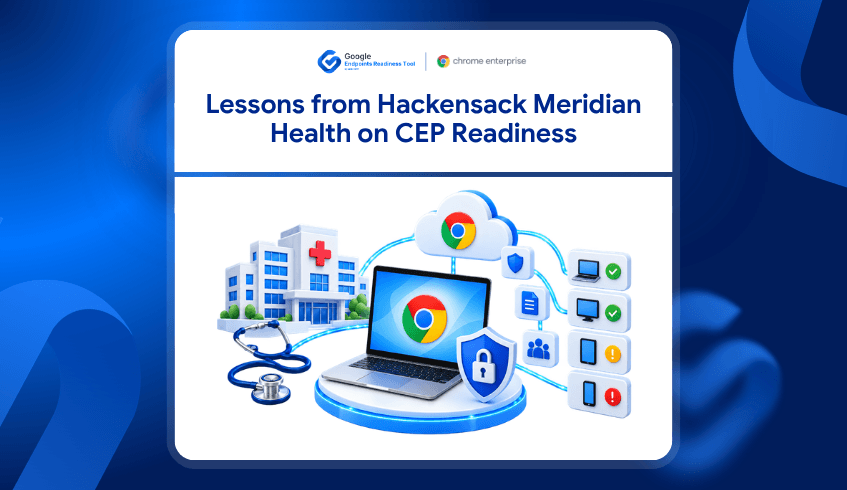
What Hackensack Meridian Health (HMH) Shows About CEP Readiness in Healthcare
Healthcare organizations increasingly depend on the browser to give clinicians and staff access to patient information, cloud applications, internal systems, and everyday business tools. As more of that work moves into the browser, protecting the browser environment becomes an important part of protecting sensitive healthcare data.
Hackensack Meridian Health’s Chrome Enterprise journey provides a strong real-world example. The healthcare network standardized on Chrome Browser and manages around 60,000 browsers across more than 500 locations. Google reports that browser-related support tickets dropped by 25%, while HMH also strengthened visibility, extension management, and secure access to patient information.
Google’s Chrome Enterprise Premium documentation also highlights HMH as a healthcare customer using advanced Chrome Enterprise security to help secure endpoint access to patient data while reducing support requirements.
For another healthcare organization considering a similar secure-browser strategy, however, selecting Chrome Enterprise Premium is only part of the journey.
The next question is:
Is the current endpoint environment actually ready for CEP deployment?
That is where Google Endpoints Readiness Tool can help.
Healthcare Is Becoming More Browser-Centric
HMH operates across hospitals, ambulatory care centers, rehabilitation facilities, wellness locations, and other healthcare environments. Its clinicians and employees need consistent access to applications whether they are working inside healthcare facilities or remotely.
Chrome became HMH’s default browser because the organization wanted easier management, better browser-fleet visibility, less troubleshooting, and stronger extension management. Chrome Browser Cloud Management also enabled the IT team to manage browsers, accounts, and applications across its distributed environment.
This reflects a broader shift across healthcare. As electronic health records and critical applications increasingly move to the web, Google describes the browser as an important frontline for both clinical workflows and patient-data security in its healthcare-focused Chrome Enterprise update.
Chrome Enterprise Premium Adds Protection Where Healthcare Work Happens
For healthcare organizations, secure enterprise browsing is not simply about managing a browser.
Chrome Enterprise Premium adds browser-level security capabilities designed to help protect sensitive information and secure access to healthcare applications. Google highlights capabilities such as data loss prevention, threat protection, real-time URL scanning, phishing and malware protection, and controls around actions such as copy and paste, printing, and screen capture.
Google is also expanding Chrome Enterprise integrations for healthcare workflows, including work involving Epic, Imprivata, and Omnissa, with a focus on secure application access, clinician authentication, device health, and modernized clinical workflows.
The value is clear. But deploying advanced browser security across a healthcare environment can involve thousands of devices, multiple locations, different user groups, existing policies, networks, applications, and legacy dependencies.
That makes deployment readiness important.
Secure Browser Adoption Starts With Knowing Whether the Environment Is Ready
HMH shows what secure and centrally managed browser adoption can support at healthcare scale.
But another healthcare organization cannot assume its own environment is immediately ready for the same type of rollout.
Some devices may be prepared for CEP deployment. Others may have technical or operational conditions that need review first. Existing policies, network conditions, device configurations, or legacy dependencies may also influence how smoothly deployment can proceed.
Discovering those issues after rollout begins can create additional troubleshooting and deployment effort.
Identifying them earlier gives IT and security teams more room to plan.
Google Endpoints Readiness Tool Helps Teams Check CEP Deployment Readiness First
Google Endpoints Readiness Tool is an enterprise readiness assessment platform that helps IT and security teams understand whether their current environment is ready for Chrome Enterprise Premium, ChromeOS, and secure enterprise browsing.
For organizations considering CEP, CEP Deployment Readiness Insights helps assess device readiness before deployment and identify potential issues or blockers that may need attention first. The current Google Endpoints Readiness Tool Insights content positions CEP readiness around understanding whether devices, browsers, policies, networks, and existing environments are prepared before rollout.
This allows healthcare IT teams to move from a broad question such as:
“Should we adopt stronger browser security?”
to more practical deployment questions:
Which endpoints appear ready to move forward?
Which devices need further review?
Where could deployment issues create friction?
Which areas should be addressed before rollout expands?
Instead of approaching CEP as one fleet-wide switch, teams can use readiness information to plan deployment around the condition of their actual environment.
From Healthcare Security Goals to a Practical CEP Rollout
Hackensack Meridian Health demonstrates the value of treating the browser as an important enterprise platform.
With tens of thousands of browsers across hundreds of locations, HMH gained centralized management, better visibility, reduced troubleshooting, and secure access to patient information.
For healthcare organizations looking toward Chrome Enterprise Premium, Google Endpoints Readiness Tool supports the stage before that outcome.
It helps IT and security teams understand whether the endpoint environment is prepared for CEP deployment and where additional attention may be required before security controls are rolled out more widely.
The connection is straightforward:
Chrome Enterprise Premium helps strengthen secure enterprise browsing. Google Endpoints Readiness Tool helps organizations understand whether their environment is ready to deploy it.
Why Readiness Matters More in Healthcare
Healthcare environments rarely consist of one type of user working from one type of device.
Clinicians, administrators, remote employees, call-center teams, and other staff may access different applications across hospitals, clinics, offices, and remote environments. HMH itself illustrates this complexity across more than 500 locations and a wide range of healthcare workflows.
A readiness-based approach helps teams identify where CEP deployment may be straightforward and where additional preparation is needed before expanding.
For healthcare IT, that means the move toward stronger browser security can be planned around the real endpoint environment rather than assumptions.
From Browser Visibility to Secure Healthcare Readiness
Hackensack Meridian Health shows what can happen when the browser becomes a managed and secure part of the healthcare environment.
For organizations considering the next step with Chrome Enterprise Premium, the goal should not simply be to deploy advanced security controls as quickly as possible.
The goal is to understand the environment first.
Google Endpoints Readiness Tool helps healthcare IT and security teams assess CEP deployment readiness, identify areas that may need attention, and build a more informed path toward secure enterprise browsing.
FAQ
Did Hackensack Meridian Health use Google Endpoints Readiness Tool?
The customer story does not state that HMH used Google Endpoints Readiness Tool. HMH is used here as a real-world healthcare example of secure Chrome adoption and Chrome Enterprise security at scale.
Why is HMH relevant to Chrome Enterprise Premium?
Google’s Chrome Enterprise Premium documentation highlights Hackensack Meridian Health as a healthcare customer using advanced Chrome Enterprise security to help secure endpoint access to patient data while reducing support requirements.
How does Google Endpoints Readiness Tool connect to this use case?
Google Endpoints Readiness Tool helps organizations assess whether their existing endpoint environment is ready for Chrome Enterprise Premium deployment and identify potential issues that may need review before rollout. Explore Google Endpoints Readiness Tool Insights.
Why does CEP readiness matter in healthcare?
Healthcare environments can span many devices, locations, applications, policies, and user groups. Understanding endpoint readiness before deployment can help teams identify potential issues earlier and plan CEP rollout more effectively.